Summary: Spirits Rock is a signposted Aboriginal engraving site at the end of the Cowan Trail, which has a number of figures, including a large and detailed engraving of the Baiame deity.

Spirits Rock is at the end of the Cowan Trail (which branches off the Long Trail): a small, signposted Aboriginal engraving site with a number of carved figures. It suffered some damage in the 1970s from people riding across the platform, and some misguided efforts to regroove some of the figures. Near the centre of the Spirits Rock site is a large and detailed engraving of Baiame.
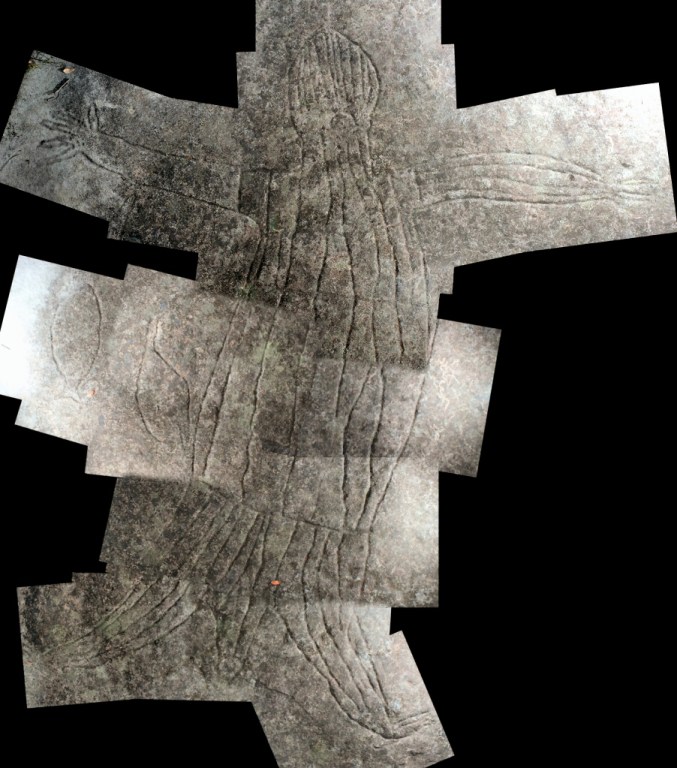
baiame Spirits Rock (Cowan Trail)
Source: Sydney Rock Art

The site features a number of men, in different poses.

IMG 1943 LR Spirits Rock (Cowan Trail)IMG 1943 LR highlighted Spirits Rock (Cowan Trail)

Another engraving of a man.

IMG 1939 LR Spirits Rock (Cowan Trail)IMG 1939 LR highlighted Spirits Rock (Cowan Trail)

Below this one of the men is a shield; it seems to have only a vertical line, which is unusual.

IMG 7394 LR Spirits Rock (Cowan Trail)IMG 7394 LR highlighted Spirits Rock (Cowan Trail)

Another two men near one another have what appears to be a a headress.

IMG 1941 LR Spirits Rock (Cowan Trail)IMG 1941 LR highlighted Spirits Rock (Cowan Trail)
Subscribe via Email

Enter your email address to subscribe to Hiking the World, and receive notifications of new posts by email. (A hike is added every 1-2 weeks, on average.)

Join 548 other subscribers

3 Comments

ian jacobs · June 25, 2021 at 12:33 pm

It may be of some interest to know that all the engraved images of Daramullan and other sky heroes in the Sydney area are oriented with the head east of the body

Wildflowers on the Cowan Trail | Hiking the World · August 26, 2021 at 8:51 pm

[…] the end of Cowan Trail is Spirits Rock, a signposted Aboriginal site which I visited a few months ago – the fairly well-preserved […]

Leave a Reply

Aboriginal Sites by National Park

Red Hands Cave, Glenbrook (Blue Mountains)
The Blue Mountains National Park (and surrounding areas along the Great Western Highway) is thought to have over a thousand indigenous heritage sites, although much of the park has not been comprehensively surveyed. The Aboriginal rock sites in the Blue Mountains include grinding grooves, stensils, drawing and rock carvings.
A review of different techniques for photographing Aboriginal rock art. This includdes oblique flash, chain and planar mosaic imaging which combines hundreds of overlapping photos.
Hornsby Shire - which is the largest LGA in the Greater Sydney Metropolitan region - contains approximately 600 recorded Aboriginal rock art sites (and over 1,200 Aboriginal heritage sites). These date back from thousands of years to post-European contact art.
Over 40 sites have been recorded within the park; many were located along the river bank and were flooded by the building of the weir in 1938.
The Greater Blue Mountains World Heritage Area protects over 3,000 known Aboriginal heritage sites, and many more which are yet to be recorded. This area includes the Blue Mountains National Park, Gardens of Stone, Wollemi National Park and Yengo National Park.
Yengo National Park was an important spiritual and cultural place for the Darkinjung and Wonnarua People for thousands of years, and 640 Aboriginal cultural sites are recorded in the park and nearby areas.