Summary: Located along the Kamber Road Trail is an Aboriginal engraving of a man, with upright hands.

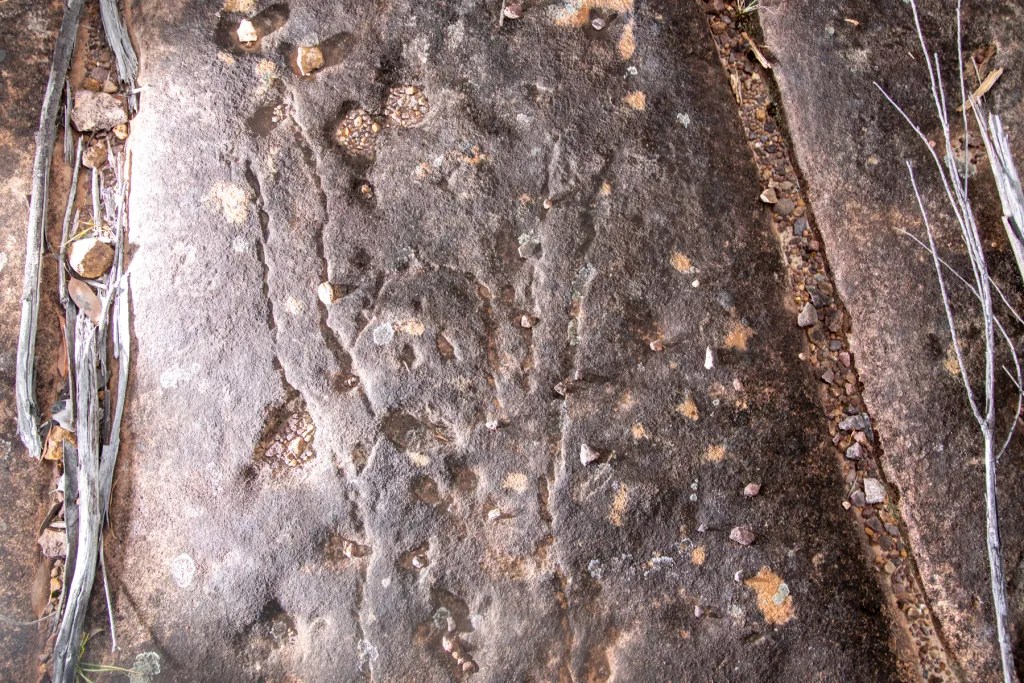
Along the Kamber Road Trail is this Aboriginal engraving of a man: “A human figure, probably a man, with his head defined as an oval, two slit eyes and no hands. The bottoms of his feet have weathered away”.

AWAT3864 LR Kamber Road Man

While the outline of the man is “well preserved in the hard ferruginous sandstone”, the grooves are very rough and you can still see the punctures.
A “beautiful little wallaby” is nearby, but has not yet been located.

This site forms part of a series of seven described by McCarthy in this area:

  1. Line of eight fish near West Head Road (S1) – most likely destroyed
  2. Goanna near McCarrs Creek (S2) – not yet found
  3. Daramulan figure and kangaroo (S3) near Duckholes Trail – this site
  4. School of six fish and pregnant woman (S4) in McCarrs Creek – not yet found
  5. Large whale and man (S5) near Mona Vale Road
  6. Shields and wallaby (S6) above Deep Creek – this site
  7. Man along Kamber Trail (S7) – this one
Subscribe via Email

Enter your email address to subscribe to Hiking the World, and receive notifications of new posts by email. (A hike is added every 1-2 weeks, on average.)

Join 756 other subscribers

0 Comments

Leave a Reply

Avatar placeholder

Aboriginal Sites by National Park

Yengo National Park was an important spiritual and cultural place for the Darkinjung and Wonnarua People for thousands of years, and 640 Aboriginal cultural sites are recorded in the park and nearby areas.
Hornsby Shire - which is the largest LGA in the Greater Sydney Metropolitan region - contains approximately 600 recorded Aboriginal rock art sites (and over 1,200 Aboriginal heritage sites). These date back from thousands of years to post-European contact art.
Red Hands Cave, Glenbrook (Blue Mountains)
The Blue Mountains National Park (and surrounding areas along the Great Western Highway) is thought to have over a thousand indigenous heritage sites, although much of the park has not been comprehensively surveyed. The Aboriginal rock sites in the Blue Mountains include grinding grooves, stensils, drawing and rock carvings.
A review of different techniques for photographing Aboriginal rock art. This includdes oblique flash, chain and planar mosaic imaging which combines hundreds of overlapping photos.