Summary: The Coat of Arms Cave or Koh shelter in the Canoelands area contains considerable Aboriginal rock art, with over 50 figures in red ochre, white and charcoal.

The Coats of Arms (or Koh) shelter in the Canoelands area contains considerable Aboriginal rock art, and has been associated with the Canoelands 1 and Canoelands 2 sites. The relatively small shelter has over 50 motifs.

The shelter gets its informal “Coat of Arms” name from a wallaby/kangaroo and emu that appear – like a coat of arms – above the entrance.

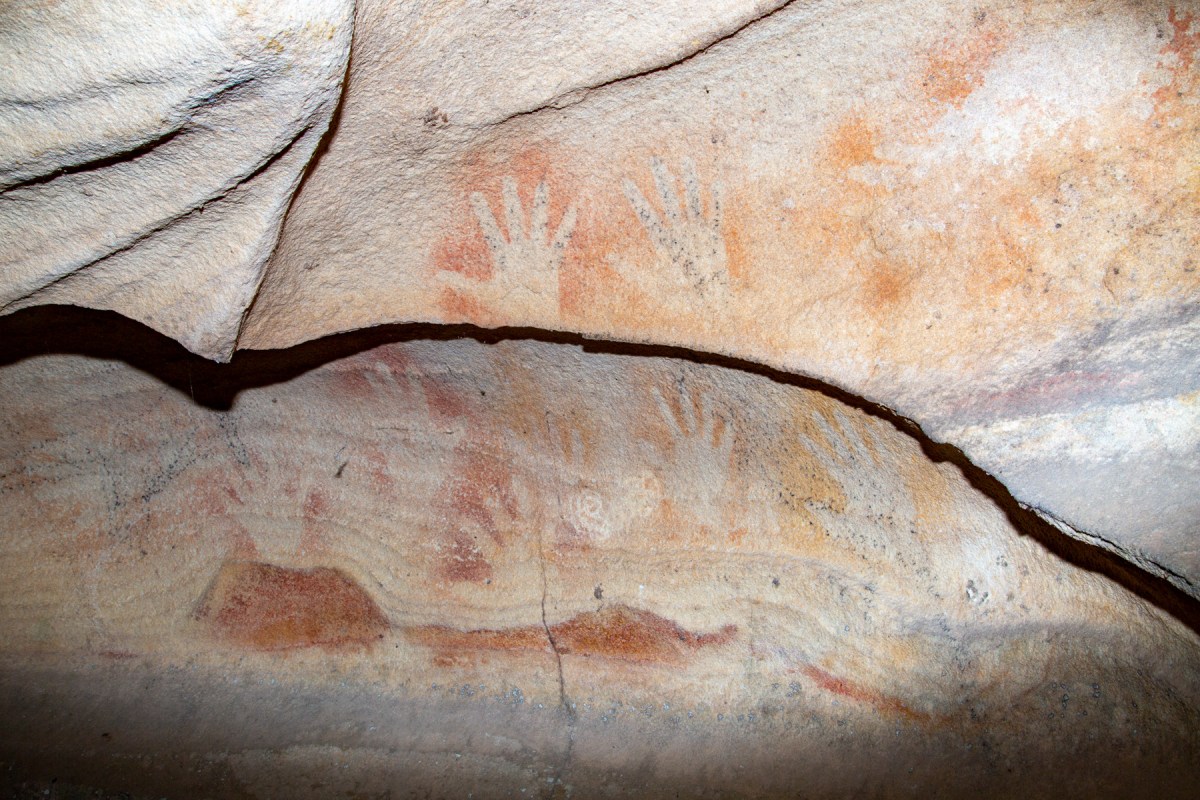
On the inside back wall of the shelter are numerous motifs. From right to left, there are at least 30 hand stencils in red ochre.

1X3A0423 LR Coat of Arms Cave (Canoelands)1X3A0423 LR yre Coat of Arms Cave (Canoelands)

Overlapping with some of the stencils above is what appears to be an echidna, in charcoal.

Next to the echidna is the outline of a boomerang,

More red ochre stencils continue across the back wall of the shelter.

1X3A0424 LR Coat of Arms Cave (Canoelands)1X3A0424 LR yre Coat of Arms Cave (Canoelands)

1X3A0426 LR Coat of Arms Cave (Canoelands)1X3A0426 LR yrd Coat of Arms Cave (Canoelands)

Next is a complex panel with many overlapping figures: most obvious are two hand stencils and multiple charcoal figures; there are some less distinct figures in red ochre.

1X3A0439 LR Coat of Arms Cave (Canoelands)1X3A0439 LR lbk Coat of Arms Cave (Canoelands)

Another panel has a number of charcoal figures that look like birds or emus as well as boomerang stencil; hidden behind the charcoal motifs are at least two red ochre hand stencils.

1X3A0449 LR Coat of Arms Cave (Canoelands)1X3A0449 LR ywe Coat of Arms Cave (Canoelands)

Above these figures are four charcoal motifs of that resembele birds.

A third boomerang stencil is next to another hand stencil.

Similar to the “coat of arms” on the outside of the shelter, two birds face each other on the right-hand side of the back wall.

1X3A0459 LR Coat of Arms Cave (Canoelands)1X3A0459 LR yrd Coat of Arms Cave (Canoelands)

Subscribe via Email

Enter your email address to subscribe to Hiking the World, and receive notifications of new posts by email. (A hike is added every 1-2 weeks, on average.)

Join 649 other subscribers

0 Comments

Leave a Reply

Aboriginal Sites by National Park

Red Hands Cave, Glenbrook (Blue Mountains)
The Blue Mountains National Park (and surrounding areas along the Great Western Highway) is thought to have over a thousand indigenous heritage sites, although much of the park has not been comprehensively surveyed. The Aboriginal rock sites in the Blue Mountains include grinding grooves, stensils, drawing and rock carvings.
Yengo National Park was an important spiritual and cultural place for the Darkinjung and Wonnarua People for thousands of years, and 640 Aboriginal cultural sites are recorded in the park and nearby areas.
Located to the north-west of Sydney, just south of the Dharug and Yengo National Parks, Maroota has a high concentration of (known) Aboriginal sites. Many more Aboriginal heritage sites are located in the Marramarra National Park. The original inhabitants of the area were the Darug people.
The Greater Blue Mountains World Heritage Area protects over 3,000 known Aboriginal heritage sites, and many more which are yet to be recorded. This area includes the Blue Mountains National Park, Gardens of Stone, Wollemi National Park and Yengo National Park.