Summary: A small shelter with Aboriginal rock art on the wall and ceiling, including birds, men and a woman.

On the the roof of a shelter along Angorawa Creek in Wollemi National Park is a series of five or six birds, drawn in charcoal.

On the wall of the shelter is part of another bird.

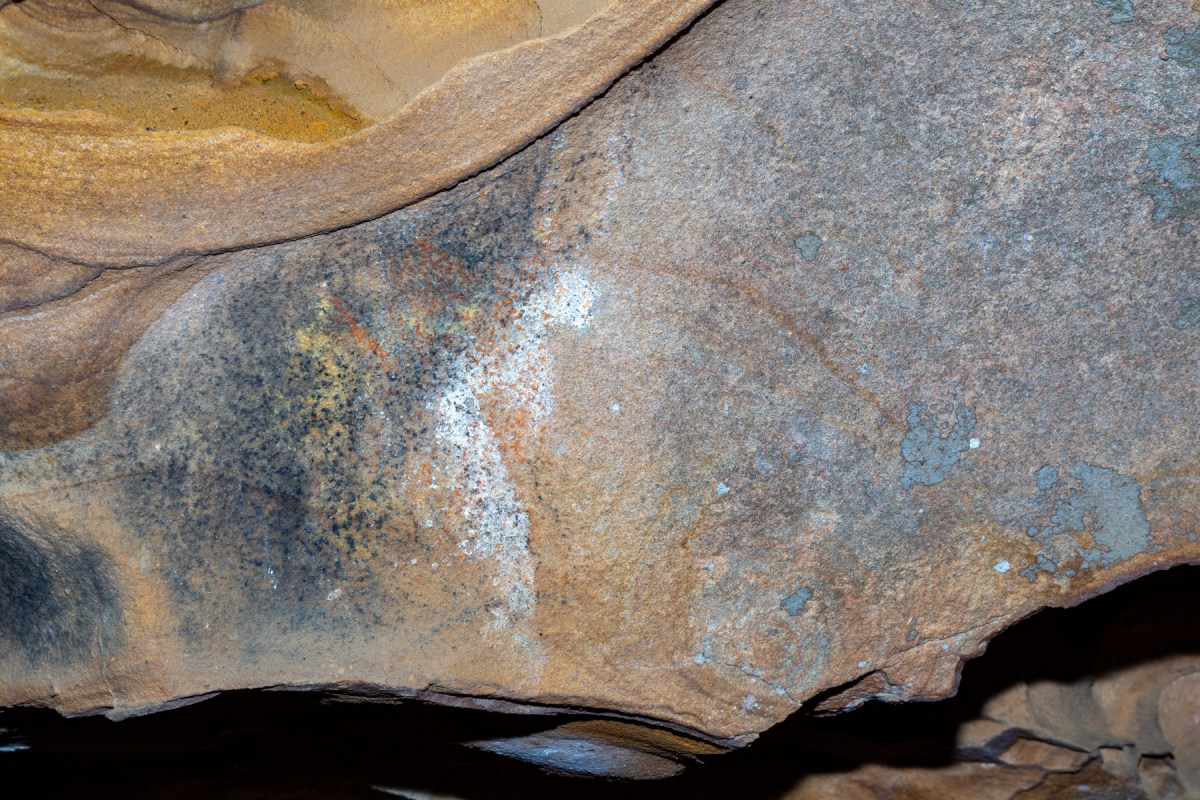
Also in charcoal is another figure which may be a human.

This figure appears to be a woman, with breasts below upraised arms.

1X3A9767 LR Angorawa Creek Charcoal Birds1X3A9767 LR lds Angorawa Creek Charcoal Birds

A human figure – also with upraised arms – is drawn in red ochre.
1X3A9775 LR Angorawa Creek Charcoal Birds1X3A9775 LR yrd Angorawa Creek Charcoal Birds

Hard to see arwe some lines in red ochre.

1X3A9759 LR Angorawa Creek Charcoal Birds1X3A9759 LR yre Angorawa Creek Charcoal Birds

The shelter is fairly weathered, with only a few smooth surfaces suitable for rock art.

Subscribe via Email

Enter your email address to subscribe to Hiking the World, and receive notifications of new posts by email. (A hike is added every 1-2 weeks, on average.)

Join 634 other subscribers

0 Comments

Leave a Reply

Aboriginal Sites by National Park

Red Hands Cave, Glenbrook (Blue Mountains)
The Blue Mountains National Park (and surrounding areas along the Great Western Highway) is thought to have over a thousand indigenous heritage sites, although much of the park has not been comprehensively surveyed. The Aboriginal rock sites in the Blue Mountains include grinding grooves, stensils, drawing and rock carvings.
Located to the north-west of Sydney, just south of the Dharug and Yengo National Parks, Maroota has a high concentration of (known) Aboriginal sites. Many more Aboriginal heritage sites are located in the Marramarra National Park. The original inhabitants of the area were the Darug people.
The Greater Blue Mountains World Heritage Area protects over 3,000 known Aboriginal heritage sites, and many more which are yet to be recorded. This area includes the Blue Mountains National Park, Gardens of Stone, Wollemi National Park and Yengo National Park.
Hornsby Shire - which is the largest LGA in the Greater Sydney Metropolitan region - contains approximately 600 recorded Aboriginal rock art sites (and over 1,200 Aboriginal heritage sites). These date back from thousands of years to post-European contact art.