Summary: Eleven red ochre hand stencils in a rock shelter near Alan Road (partially destroyed in 1985)

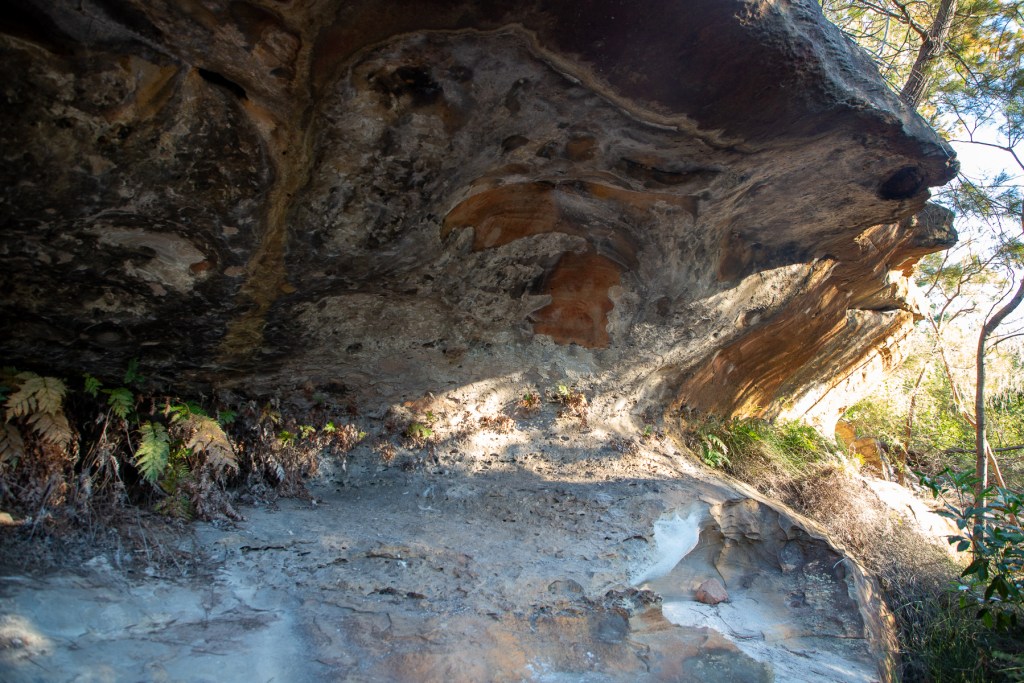
One of two shelters containing Aboriginal art near Alan Road, the western part of this sandstone overhang was destroyed in March 1985 when the Metropolitan Water and Sewerage Board cleared an access track to a proposed sewerage shaft near Joe Crafts Creek.

Damage 45 6 1186 Alan Road Shelter (stencils)
Source: NPWS
AWAT4554 LR Alan Road Shelter (stencils)

While part of the rockshelter was reduced to rubble before the construction work was stopped, sixteen hand stencils survived in the right-hand section of the overhang (also referred to as the eastern shelter).
AWAT4550 LR Alan Road Shelter (stencils)

Eleven of the red ochre hand stencils are still visible.

Subscribe via Email

Enter your email address to subscribe to Hiking the World, and receive notifications of new posts by email. (A hike is added every 1-2 weeks, on average.)

Join 649 other subscribers

0 Comments

Leave a Reply

Aboriginal Sites by National Park

Yengo National Park was an important spiritual and cultural place for the Darkinjung and Wonnarua People for thousands of years, and 640 Aboriginal cultural sites are recorded in the park and nearby areas.
Located to the north-west of Sydney, just south of the Dharug and Yengo National Parks, Maroota has a high concentration of (known) Aboriginal sites. Many more Aboriginal heritage sites are located in the Marramarra National Park. The original inhabitants of the area were the Darug people.
The Greater Blue Mountains World Heritage Area protects over 3,000 known Aboriginal heritage sites, and many more which are yet to be recorded. This area includes the Blue Mountains National Park, Gardens of Stone, Wollemi National Park and Yengo National Park.
A review of different techniques for photographing Aboriginal rock art. This includdes oblique flash, chain and planar mosaic imaging which combines hundreds of overlapping photos.